 -by
-by Introduction: The Shift from Degrees to Skills
The way people learn—and the way companies hire—has fundamentally changed. Traditional degree-based education is no longer sufficient to keep pace with rapid technological advancements, evolving job roles, and dynamic industry demands. Today, skills matter more than credentials.
This shift has given rise to skill-based learning, a modern approach to education that focuses on practical, job-ready capabilities rather than purely academic theory. At the center of this transformation stands SkillElevator, a future-ready learning platform designed to help individuals and organizations stay relevant, competitive, and skilled.
What Is Skill-Based Learning?
Skill-based learning is an educational approach that prioritizes the development of specific, measurable, and industry-relevant skills. Instead of emphasizing time spent in classrooms or theoretical examinations, it focuses on:
- Practical, hands-on learning
- Real-world problem solving
- Industry-aligned competencies
- Continuous upskilling and reskilling
Learners progress by mastering skills, not just completing courses. This model is particularly effective for fast-evolving fields such as technology, data, AI, cloud computing, business analytics, and digital transformation.
Why Skill-Based Learning Matters in Today’s Job Market
1. Rapid Technological Change
Technologies evolve faster than traditional curricula can adapt. Skill-based learning ensures learners acquire current and in-demand skills, not outdated knowledge.
2. Employer-Driven Hiring
Organizations increasingly hire based on what candidates can do, not just what degrees they hold. Skills-based credentials improve employability and career mobility.
3. Lifelong Learning Is Essential
Careers are no longer linear. Professionals must continuously upgrade their skills to remain relevant—and skill-based learning supports this ongoing growth.
4. Faster Career Outcomes
Unlike long academic programs, skill-based learning delivers shorter, outcome-oriented learning paths that lead directly to real-world application.
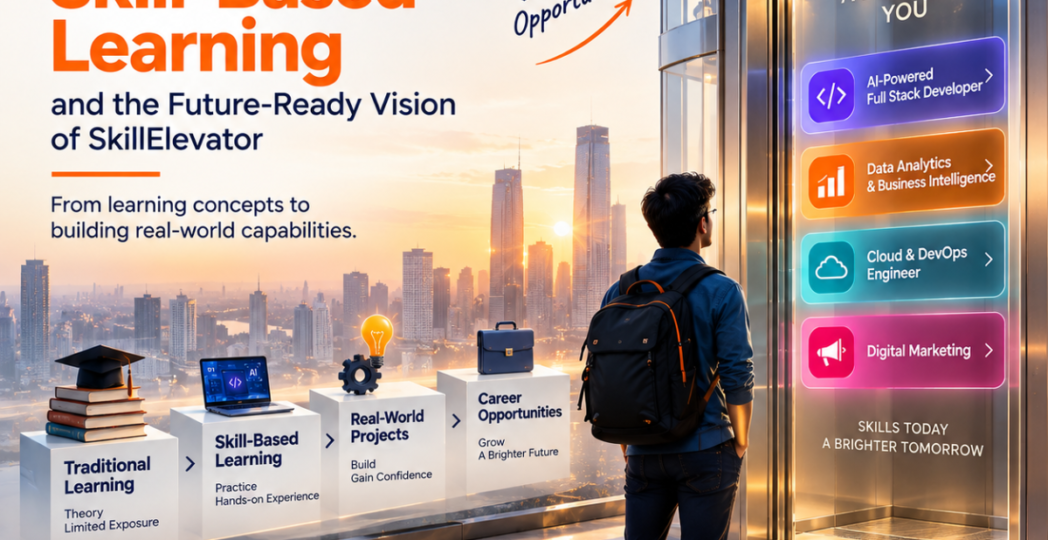
Traditional Learning vs Skill-Based Learning
| Traditional Learning | Skill-Based Learning |
| Theory-heavy | Practical and hands-on |
| Time-bound degrees | Outcome-driven skill paths |
| Static curriculum | Continuously updated |
| Limited industry alignment | Strong industry relevance |
| Slow ROI | Faster career impact |
This comparison highlights why individuals and enterprises alike are transitioning toward skill-centric education models.
Why SkillElevator Is Built for the Future
SkillElevator is not just another online learning platform—it is a strategic skill development ecosystem designed for the future of work.
1. Industry-Relevant Skill Paths
SkillElevator programs are curated around real-world job roles, industry trends, and emerging technologies. Every course is designed with practical outcomes in mind.
2. Learn by Doing
The platform emphasizes hands-on learning, real-life use cases, projects, and applied knowledge—ensuring learners can confidently apply skills in real scenarios.
3. Designed for Modern Professionals
SkillElevator supports flexible, self-paced, and guided learning models, making it ideal for:
- Working professionals
- Career switchers
- Fresh graduates
- Corporate upskilling initiatives
4. Enterprise & Future Workforce Ready
SkillElevator aligns learning with enterprise needs, digital transformation goals, and future workforce requirements—bridging the gap between education and industry.
5. Continuous Upskilling Culture
Rather than one-time learning, SkillElevator promotes continuous skill elevation, helping learners stay relevant as industries evolve.
How Skill-Based Learning with SkillElevator Drives Career Growth
SkillElevator empowers learners to:
- Build job-ready skills faster
- Gain confidence through practical exposure
- Adapt to emerging technologies
- Improve employability and career mobility
- Stay competitive in a global job market
For organizations, it enables structured upskilling, reduced skill gaps, and a more agile workforce.
The Future of Learning Is Skill-First
As automation, AI, and digital transformation reshape industries, the future belongs to those who can learn, adapt, and apply skills quickly. Skill-based learning is no longer optional—it is essential.
SkillElevator is built for this future—a future where learning is practical, outcomes matter, and skills define success.
Conclusion
Skill-based learning represents a powerful shift in how individuals prepare for careers and how organizations build talent. By focusing on practical skills, real-world relevance, and continuous growth, it addresses the demands of the modern workforce.
SkillElevator stands at the forefront of this transformation, offering a future-ready platform designed to elevate skills, careers, and organizations—today and tomorrow.